

Put students in pairs and have each reread one of the articles, underlining details that support why eating jellyfish is a good idea. Then have them share what they underlined and work on the writing prompt as a team.
Back to Teacher View
Student View
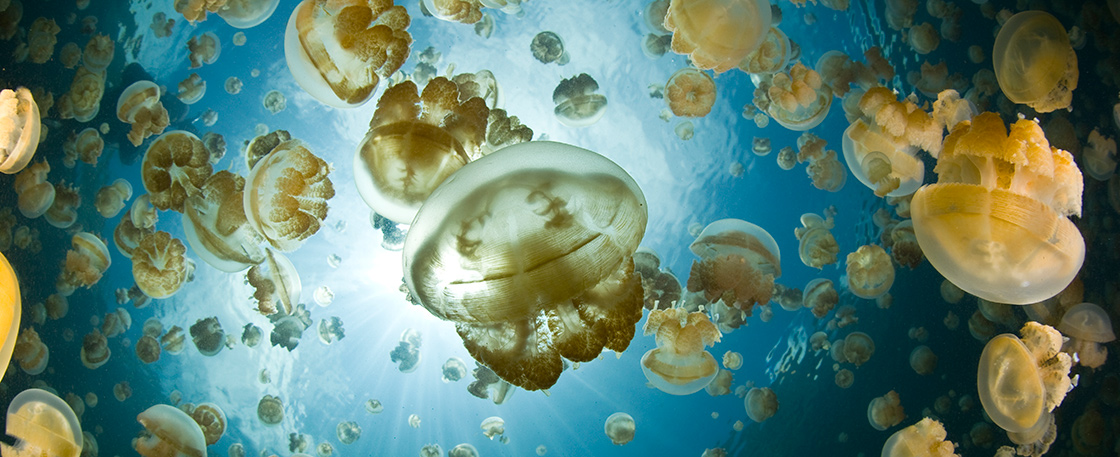
ETHAN DANIELS/WATERFRAME RM/GETTY IMAGES
Invasion of the Jellyfish
Trillions of slimy blobs are taking over our oceans. Can they be stopped? We’ve paired a fascinating article about jellyfish overpopulation with an informational text on a possible solution to the problem.
By Tod Olson
From the February 2018 Issue
Learning Objective: Students will identify a problem with an ocean species and explore a possible solution.
Lexile: 710L, 580L
Guided Reading Level: T
DRA Level: 50
Core Skill:
Problem and Solution,
Topics:
Animals,
Standards
Audio
()
Activities
(9)
Core Skills Workout
Skills Activities
Quizzes
(2)
Quizzes
(2)
Answer Key
(2)
Answer Key
(2)
Audio
()
Activities
(9)
Download All Activities
Core Skills Workout
Skills Activities
Quizzes
(2)
Quizzes
(2)
Answer Key
(2)
Answer Key
(2)
More About the Story
Skills
problem and solution, vocabulary, author’s craft, text evidence, inference, cause and effect, main idea, key details, synthesizing, opinion and explanatory writing
Complexity Factors
Purpose
The first article explains the causes and effects of jellyfish overpopulation. The second explores a potential solution.
Structure
The first article uses a cause-and-effect structure. Read together, the articles present a problem and possible solution.
Language
The articles include some challenging academic and domain-specific vocabulary (e.g., horde, population explosion, global warming, biologist).
Knowledge Demands
Basic knowledge of ecosystems will aid comprehension. Cooling systems, nuclear power plants, and the U.S. Navy are mentioned. The articles also refer to numerous geographical places, such as the Philippines, the Mediterranean Sea, and Sweden, as well as large numbers like 150 million.
Step-by-Step Lesson Plan
1. Preparing to Read
Preview Text Features and Vocabulary (20 minutes, activity sheet online)
- As a class, look at the photo and headline on pages 16-17. Discuss what the word invasion means and what mood the image creates.
- Read aloud the Up Close box on page 16 for the class. Ask: What do you think the main problem of the article will be?
- Show the vocabulary slideshow or distribute the vocabulary activity to preview challenging words. Highlighted words: species, tentacles, venom, population explosion, competition, global warming, biologist, nutritious
2. Close Reading
Read and Unpack the Text (45 minutes, activity sheet online)
Ask students to read both articles. Then have groups answer the close-reading questions. Discuss the critical-thinking questions as a class.
“Invasion of the Jellyfish”
Close-Reading Questions
- Reread the first section of the article. Why do you think the author waits until the last line of the section to reveal that the “scary beasts” are jellyfish? (author’s craft)
Most people do not think of jellyfish as “scary beasts.” By painting a picture of frightening, violent monsters before revealing that the monsters are jellyfish, the author creates a sense of surprise that hooks the reader’s interest. - In “Jellies, Jellies Everywhere,” the author writes that “jellyfish rule the ocean.” What details in the section support this statement? (text evidence)
Details include that thousands of jellyfish are washing onto Australian beaches; that there are millions in Japanese waters; and that there are four times as many jellyfish in the Mediterranean Sea today as there were 13 years ago.
- In the first paragraph of “Taking Over,” what impression does the author give of jellyfish? Why might he describe them this way? (inference)
The author gives an impression of jellyfish as dull, unintelligent creatures; he calls them “lifeless blobs.” He likely describes them this way to emphasize how strange it is that such creatures are taking over the oceans.
- What characteristics of jellyfish have helped their numbers grow? (cause and effect)
Jellyfish multiply quickly. They gobble up the eggs and food of other creatures, killing off competition. Plus, they’re tough: Unlike many other sea animals, they can survive in polluted and warm waters. (Some even have more babies in such conditions.)
- In what ways are humans responsible for the jellyfish population explosion? (cause and effect)
Humans catch and eat many of the fish that eat jellyfish. They also pollute rivers and oceans with chemicals and create air pollution that heats up ocean water. These conditions kill many species, but not jellyfish.
"Jellyfish for Dinner?"
Close-Reading Questions
- What is the main idea of the informational text? (main idea)
The main idea is that people can help solve the jellyfish problem by eating jellyfish. - In what new ways are jellyfish being served? How might this help them become more popular as food? (inference)
Jellyfish are being served as snack chips, fried, deep-fried, and even in ice cream. This might help them become more popular by making them more appealing to people who are not used to eating jellyfish. - According to the article, how do jellyfish chips compare with potato chips? (key details)
Jellyfish chips are healthier than potato chips, because jellyfish contain a lot of protein and no fat.
Critical-Thinking Questions
- Using information from both articles, explain why having too many jellyfish in the ocean is a problem. (synthesizing)
First, having too many jellyfish in the ocean poses a danger to humans: The slimy creatures sting 150 million people around the world each year, and some species can even kill. They get sucked into the cooling systems of ships and power plants, causing major damage. And they crowd out other ocean creatures by attacking them and eating their eggs and food. - Imagine you’re part of a group of leaders from around the world that’s trying to find a solution to the jellyfish invasion problem. Based on what you read, come up with three recommendations. (problem and solution)
Recommendations might include encouraging people to eat less tuna and swordfish, setting rules to prevent farms and factories from releasing chemicals into our waters, taking steps to stop air pollution, and of course, helping make jellyfish popular as food.
3. Skill Building
Featured Skill: Problem and Solution
- Distribute our problem and solution activity and have students complete it in groups. Then ask them to respond to the writing prompt on page 19.
Create a Movie Trailer
- Invite students to create a trailer for a horror movie about the jellyfish invasion. They should start by writing a script that touches on at least three effects of the problem, then find photos and video clips online to illustrate it. They can record the narration using a smartphone or tablet, then edit their trailers using a program such as iMovie or WeVideo.
 Differentiate and Customize
For Struggling Readers
For Advanced Readers
Have students reread the article on their own. Then have them respond to the writing prompt, going online to find photos, charts, and diagrams that illustrate their answer. They should incorporate these text features into their final response.
For ELL Students
Many terms in the article, such as “nuclear power plant,” may be difficult for ELLs. Read the lower-Lexile version together slowly, inviting students to place sticky notes next to terms they have trouble with. Then discuss the meanings of the flagged terms as a group.
For Research
Have students research another animal whose numbers have risen dramatically (e.g., the white-tailed deer). Then ask them to write a short essay comparing the effects of that animal’s population explosion with the effects of the jellyfish’s.
Text-to-Speech