


Divide students into two groups. Have one group summarize life for Natalia’s village before the well was installed, and the other summarize life after it was installed. Then have each group present its summary to the other.
Back to Teacher View
Student View
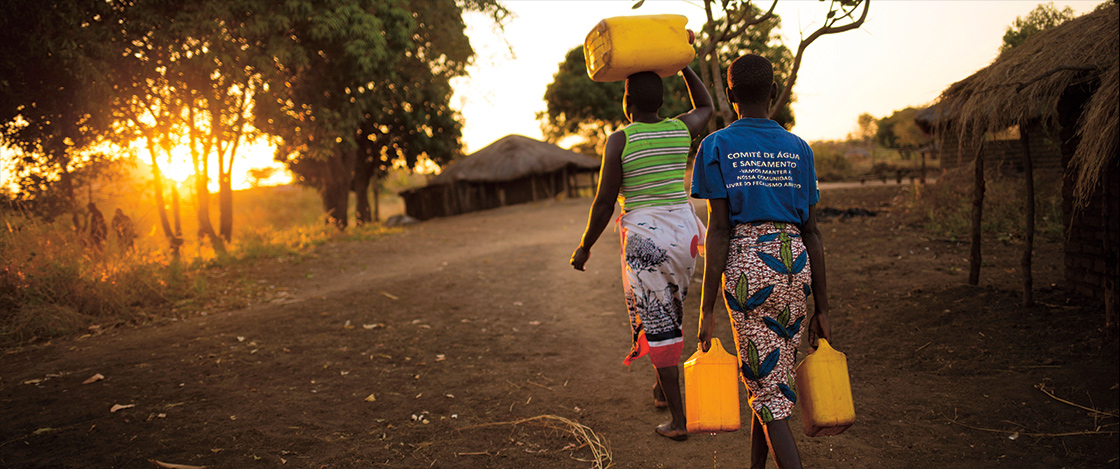
COURTESY OF MORRIS WEINTRAUB/CHARITY: WATER
Two Miles for a Drink of Water
This powerful article will introduce your students to Natalia, a young girl from Mozambique who once spent hours fetching water for her family—until a new well changed her life forever. We’ve paired it with an interview with Mari Copeny, a 10-year-old fighting for safe drinking water in Flint, Michigan.

By Kristin Lewis
From the March / April 2018 Issue
Learning Objective: Students will compare and contrast the experiences of two girls whose communities have faced water problems.
video
(1)
Audio
()
Activities
(9)
Core Skills Workout
Skills Activities
Quizzes
(2)
Quizzes
(2)
Answer Key
(2)
Answer Key
(2)
video
(1)
Audio
()
Activities
(9)
Download All Activities
Core Skills Workout
Skills Activities
Quizzes
(2)
Quizzes
(2)
Answer Key
(2)
Answer Key
(2)
More About the Story
Skills
compare and contrast, vocabulary, supporting details, text features, problem and solution, key details, cause and effect, inference, critical thinking, narrative writing
Complexity Factors
Purpose
The feature explores the problem of water scarcity around the world through the stories of two girls: Natalia, a 13-year-old living in rural Mozambique, and Mari, a 10-year-old who has been working to help solve the water crisis in Flint, Michigan.
Structure
The first article is mainly chronological and includes problem-and-solution and cause-and-effect structures. The second is presented in a question-and-answer format.
Language
The feature is composed of mostly short, clear sentences, but includes some challenging vocabulary (e.g. developing countries, contaminated, crisis).
Knowledge Demands
Some background knowledge of developing countries may aid in comprehension but is not required. Familiarity with the recent water contamination crisis in Flint, Michigan, may be helpful for the pairing.
Step-by-Step Lesson Plan
1. Preparing to Read
Preview Text Features and Vocabulary (20 minutes, activity sheet online)
- As a class, study the photos, captions, title, and subhead on page 15. Invite students to predict how Natalia’s life “changed forever.” Then read aloud the Up Close box at the bottom of the page.
- Distribute the vocabulary activity to introduce challenging words in the text. Highlighted terms: briskly, luxury, precious, developing countries, contaminated, crisis, filter
- Show our video “Behind the Scenes: Two Miles for a Drink of Water,” with author Kristin Lewis. Have students complete the video activity.
2. Close Reading
Read and Unpack the Text (45 minutes, activity sheet online)
Ask students to read both articles. Then have groups answer the close-reading questions. Discuss the critical-thinking questions as a class.
“Two Miles for a Drink of Water””
Close-Reading Questions
- In the first section of the article, which details help you understand the difficulty of fetching water? (supporting details)
Details include: Natalia “dragged herself out of bed” at 4:30 a.m.; she walked in darkness; the trip took hours; and she had to trek through “snake-filled grasses.” - According to the section “A Luxury,” how is the way Americans use water different from the way people in Natalia’s village use it? (compare and contrast)
Since most Americans get water easily, we often use it wastefully. But since Natalia’s village does not have running water, people there are much more careful when using this precious resource.
- Study the photo and read the caption on p. 17. What main idea of the article do they support? (text features)
The image and caption support the idea that in many countries, getting drinking water requires a huge amount of effort.
- Reread “On Their Own.” For the villagers, how would getting water from a well be better than getting it from a watering hole? (compare and contrast)
The water from the watering holes was extremely difficult to get and had germs that made people sick. The well water would be cleaner and safer, and girls like Natalia would not have to spend hours walking to fetch it.
- Based on the last paragraph of “On Their Own” and the section “Into Her Hands,” what problem did the village face in setting up a well? How was this problem solved? (problem and solution)
The village could not afford the machines and experts needed to dig a well. An organization called charity: water helped solve this problem by raising money to build the well and arranging for workers to set it up.
- Reread “Water Is a Gift.” In what ways has Natalia’s life changed from the beginning of the article? (compare and contrast)
At the beginning of the article, Natalia spent so much time getting water that she barely had time to go to school. At the end of the article, Natalia is able to go to class regularly and does well, moving her closer to her dream of running a school.
“Little Miss Flint”
Close-Reading Questions
- What happened in Flint, Michigan, in 2014? (key details)
In 2014, a dangerous metal called lead polluted the tap water in Flint, leaving thousands of people without clean water to drink. - According to the interview, how did the water crisis affect Mari Copeny and her family? What did this lead Mari to do? (cause and effect)
The polluted tap water gave Mari and her family bad rashes and forced them to drive to pick up bottled water. This led Mari to attend protests, write letters, and speak out to demand safe water in Flint.
Critical-Thinking Questions
- How are the challenges that Mari and Natalia have each faced similar? What is similar about how the two girls have responded to these challenges? (compare and contrast)
Both girls lived in places with polluted water that sickened their families. They had to travel to get drinking water, Natalia by foot and Mari by car. Yet both girls met these challenges with determination, confidence, and bravery. Natalia walked for hours through snakefilled fields for water, and later took charge of caring for the village well. Mari wrote to the president and called for change until people listened.
- Has reading these articles changed how you think about water and its role in your own life? Explain. (critical thinking)
Answers will vary.
3. Skill Building
Featured Skill: Compare and Contrast
Distribute our compare and contrast activity and have students complete it in groups. Then ask them to respond to the writing prompt.
Create an Awareness Poster March 22 is World Water Day, which raises awareness about the importance of access to clean water. Read about it as a class at www.worldwaterday.org. Then invite students to go online to learn more about water problems around the world and what people are doing to solve them. They can use their research to create awareness posters to display in your school for World Water Day.
 Differentiate and Customize
For Struggling Readers
For Advanced Readers
Invite students to go online to learn more about the causes and effects of the Flint water crisis. Have them choose online photos that tell the story of the crisis. Then have them write a two- to three-sentence caption for each photo, using what they’ve learned.
For ELL Students
Listen to the lower-Lexile versions of the articles together, pausing frequently to make sure students understand each section. Then, as a group, brainstorm what the conversation between the two girls might sound like; have each student suggest at least one line.
For Independent Reading
As students reread the article independently, have them complete the compare and contrast activity on their own. Students can use their completed activities to help them answer the writing prompt.
Text-to-Speech