

The vocabulary highlighted in this article is domain-specific, related to pioneer life. But students will also find some challenging academic words. Ask them to circle words they don’t know, then work with a partner to figure out their meanings.
Back to Teacher View
Student View
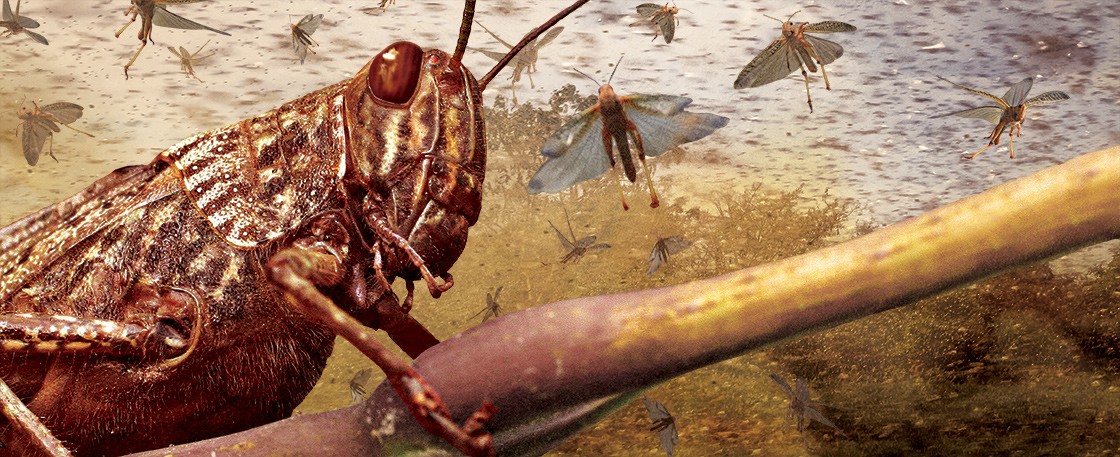
Ingo Arndt/Getty Images (background); PaoloBis/Getty Images (grasshopper); Protasov AN/Shutterstock.com (flying locusts)
Swarms of Terror
Throughout the late 1800s, grasshoppers brought destruction and ruin to pioneers across America’s West.

By Lauren Tarshis
From the December 2017 / January 2018 Issue
Learning Objective: Students will identify descriptive details in a narrative-nonfiction article and explain how the details help them understand a forgotten catastrophe.
Lexile: 700L-800L, 600L-700L
Guided Reading Level: U
DRA Level: 50
Featured Skill:
Author's Craft,
Standards
video
(1)
Audio
()
Activities
(10)
Core Skills Workout
Skills Activities
Quizzes
(2)
Quizzes
(2)
Answer Key
(2)
Answer Key
(2)
video
(1)
Audio
()
Activities
(10)
Download All Activities
Core Skills Workout
Skills Activities
Quizzes
(2)
Quizzes
(2)
Answer Key
(2)
Answer Key
(2)
More About the Story
Skills
author’s craft (descriptive details), vocabulary, text evidence, cause and effect, text features, drawing conclusions, explanatory writing
Content-Area Connections
Social studies: American history, geography
Science: insects, the environment
Complexity Factors
Purpose
“Swarms of Terror” tells the little-known story of how massive hordes of locusts plagued Western pioneers throughout the late 1800s. It also provides general information about pioneer life and the locust species that attacked.
Structure
The text is mainly chronological, with narrative and informational passages. It includes cause-and-effect structures.
Language
The article includes some challenging academic and domain-specific vocabulary having to do with pioneer life (e.g. settlers, drought, migrate). It features a wide variety of figurative language.
Knowledge Demands
Some knowledge of early American pioneers, farming, and the geography of America’s prairie may be helpful, but is not required. The text mentions the Bible, Ancient Egypt, and Antarctica.
Step-by-Step Lesson Plan
1. Preparing to Read
Preview Text Features and Vocabulary; Watch a Video (40 minutes, activity sheets online)
- Ask students to open to pages 4-5 and read the Up Close box on page 5. Show the video “Behind the Scenes: Swarms of Terror” to introduce the article’s topic and featured skill, author’s craft. Then have students complete the video activity.
- Have students peruse the article, looking at the pictures and captions. Ask them what they see that connects to what they learned in the video.
- Show the vocabulary slideshow to introduce domain-specific vocabulary having to do with pioneer life. Reinforce word learning with the vocabulary activity, or distribute it after reading. Highlighted words: pioneers, settlers, prairie, Mississippi River, drought, migrate
2. Close Reading
Read and Unpack the Text (45 minutes, activity sheet online)
- Read the article as a class, or play our audio version as students follow along. Have students read it a second time in small groups, answering the close-reading and critical-thinking questions.
Close-Reading Questions
- Reread the first paragraph of the article. What picture does it make you see in your mind? Which words help you form that image? (descriptive details)
Students will likely say the paragraph makes them picture a scary shining cloud. Words that help form the image include “shadow,” “strange shimmer,” and “something terrible.” - What was life like on the prairie in the 1800s? Support your answer with details from the first section. (text evidence)
Life was difficult and dangerous. The article describes how the Ingalls family had to get up at dawn every day and work until after dark, tending to their farm. It lists dangers, including blizzards, fevers, lightning, rattlesnakes, and wildfires. - Which details in “Click, Buzz, Whir” does the author include to help you hear, see, and feel what Laura experienced when the grasshoppers arrived? (descriptive details)
To hear the grasshoppers, the author uses words that imitate their sounds, such as whir, click, buzz, and thud. She also writes that they “sounded like thousands of giant scissors snipping away at the sky.” To see them, she describes their “spindly, creeping legs and huge bulging eyes.” To feel the grasshoppers, the author tells how they landed on Laura’s head, swished in her skirt, and got tangled in her hair. - Based on “Millions of Chomping Jaws,” why were the locusts such a huge problem? (cause and effect)
The locusts ate crops, destroying the farmers’ way to earn a living, and devoured gardens, taking away people’s source of food. Settlers were left with little or no food or money. - In “Winged Attackers,” what details help you understand how Rocky Mountain locusts were different from other locusts? (descriptive details)
The author writes that the Rocky Mountain locusts gathered in “monstrous” swarms and explains that the swarm of 1875 was 110 miles wide and 1,800 miles long. - How did the Rocky Mountain locusts finally disappear? (cause and effect)
When settlers moved to the Rocky Mountains, they tore up grass and brought in cattle, changing the natural environment. The locusts couldn’t survive the changes and died out.
Critical-Thinking Questions
- Look at the cartoon from the late 1800s on page 8. Based on what you learned in the article, why do you think the grasshopper is as big as the farmer? (text features)
The size of the grasshopper (and the fact that it’s attacking the farmer) shows what a huge menace the insects were. Although they were small individually, together in a swarm they could overpower the farmers. - The article points out that many Americans today don’t know about the grasshopper attacks settlers faced. Why might it be important to learn about them? (drawing conclusions)
Answers will vary. Students might say that learning about them makes us appreciate what settlers went through. We also learn about the power of nature. In addition, it helps us understand references to the bugs in historical works, art, or books—like Laura Ingalls Wilder’s novel!
3. Skill Building
Featured Skill: Author’s Craft
- Distribute our author’s craft activity and have students complete it in groups. Then have them respond to the writing prompt on page 9.
- Write and Perform a Skit
Have students work in groups to write skits, bringing to life the details in the first three sections of the article. The characters will be Laura and her family members. Invite students to imagine what they would say and do as the swarm of grasshoppers approaches. After they write and practice their skits, ask groups to perform them for the class.
- Try Our Brand-New Research Kit!
Use our new Research Kit activity to guide students through a research-based project related to the article.
Have students work in groups to write skits, bringing to life the details in the first three sections of the article. The characters will be Laura and her family members. Invite students to imagine what they would say and do as the swarm of grasshoppers approaches. After they write and practice their skits, ask groups to perform them for the class.
Use our new Research Kit activity to guide students through a research-based project related to the article.
 Differentiate and Customize
For Struggling Readers
For Advanced Readers
After exploring the article’s descriptive details with this lesson, have students use the article as a mentor text to write a personal narrative describing a time they were surprised by something in nature. Remind them to include powerful descriptive details.
For ELL Students
Some ELL students may not have had the same exposure to images of pioneer life as other students. To build background, look through a picture book together that features pioneers, such as Dandelions by Eve Bunting.
For Choice Time
For your students who are drawn to stories about how people lived in other times and places, suggest that they read this article on their own. In your one-on-one conferences, let them share with you their impressions of the article and what they learned from it.
Text-to-Speech