


Go through the article and timeline with students, underlining all the geographical places mentioned in them, e.g., Egypt and Peru. Then find them together on a map to help students understand these references.
Back to Teacher View
Student View
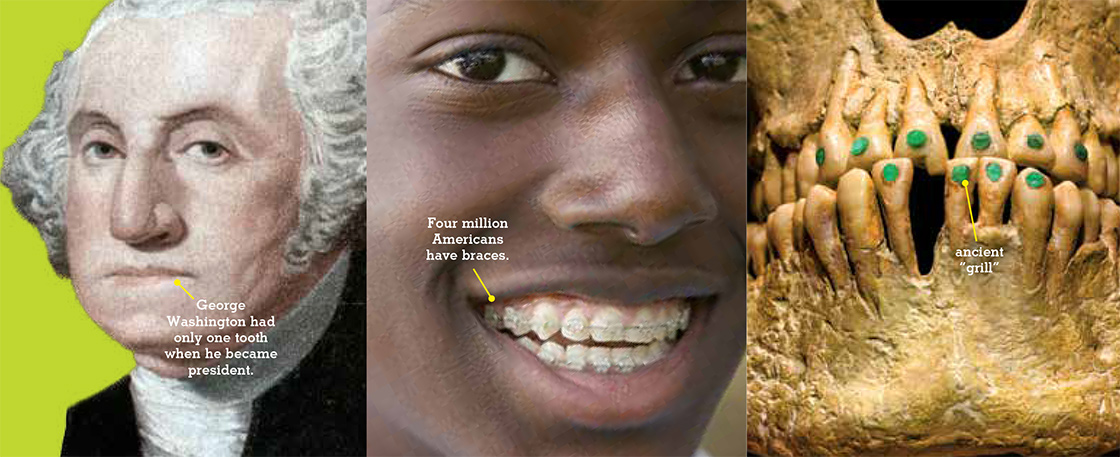
The Print Collector/Hulton Fine Art Collection/Getty Images; Monkey Business Images/shutterstock.com; Photo Illustration by Allan Davey/Sarver Mostardi/Alamy Stock Photo
The History of Teeth
A nonfiction article and timeline explore the totally gross, totally fascinating history of dentistry.

By Kristin Lewis
From the December 2017 / January 2018 Issue
Learning Objective: Students will synthesize information from an article and a timeline to build knowledge about how dental care has changed over time.
Lexile: 900L-1000L, 600L-700L
Guided Reading Level: U
DRA Level: 50
Standards
Audio
()
Activities
(8)
Core Skills Workout
Skills Activities
Quizzes
(2)
Quizzes
(2)
Answer Key
(2)
Answer Key
(2)
Audio
()
Activities
(8)
Download All Activities
Core Skills Workout
Skills Activities
Quizzes
(2)
Quizzes
(2)
Answer Key
(2)
Answer Key
(2)
More About the Story
Skills
Synthesizing, vocabulary, text features, author’s craft, text evidence, compare and contrast, key details, drawing conclusions, explanatory and narrative writing
Content-Area Connections
Science: health and medicine
Social studies: history
Complexity Factors
Purpose
The article, “The History of Teeth,” explains the dental problems people have faced since ancient times, and how they have tried to solve them. The timeline, “Teeth Through Time," adds details about tooth care through the ages.
Structure
The article is mainly chronological from ancient Egypt through the present. It starts with a narrative passage. The timeline offers seven bits of information, spanning the past 10,000 years.
Language
The feature includes some challenging academic and domain-specific vocabulary (e.g. microscopic, baffled, anesthetics).
Knowledge Demands
Numerous places and time periods are mentioned, including Egypt, Peru, and Europe; The feature also refers to Romans and ancient Hebrews.
Step-by-Step Lesson Plan
1. Preparing to Read
Preview Text Features and Vocabulary (20 minutes, activity sheet online)
- Invite students to examine the photo collage on page 16 and share what they find interesting or surprising. Ask: What do you think is important to people about their teeth? Answers may include that people want their teeth to be healthy and attractive.
- Show the vocabulary slideshow or distribute the vocabulary activity to preview challenging words. Highlighted words: microscopic, baffled, burrowed, fractured, hygienists, anesthetics, decay (in timeline)
- Call on a student to read aloud the Up Close box on page 17 for the class.
2. Close Reading
Read and Unpack the Text (45 minutes, activity sheet online)
Ask students to read the article then the timeline. Then have groups answer the close- reading questions. Discuss the critical-thinking questions as a class.
Close-Reading Questions
- Why do you think the author starts the article with a mystery about how a mummy died? (author’s craft)
The author probably starts this way to grab readers’ attention and surprise them when she reveals that the mummy died because of a bad tooth. - What details in “Terrible Fact of Life” show that tooth care was poor before the 20th century? (text evidence)
Details include that knights went to battle with oozy sores on their gums; princesses covered their rotting teeth with hankies; George Washington had only one tooth by the time he became president; and many people had lost most of their teeth by the time they were middle-aged. - Based on “Kissing a Donkey,” how were ancient people’s dental habits similar to ours? What was different about tooth care at that time? (compare and contrast)
Ancient people replaced teeth that fell out and found a way to straighten crooked teeth. But they didn’t know what caused tooth problems. - What causes cavities? How can they be prevented? (key details)
Cavities form when bacteria produce acid that eats tiny holes into teeth. Brushing, flossing, and avoiding sugary foods can help prevent cavities. - In the 1700s, what kinds of workers took care of people’s teeth? Who might their patients have been? (text evidence)
In the 1700s, dentists, barbers, and “tooth drawers” helped people with tooth problems. Only very rich people went to dentists. Ordinary people went to barbers to have bad teeth pulled. Some also saw tooth drawers, who traveled from town to town pulling teeth. - Based on “Obsessed With Teeth,” how are dentists today different from those in the past? (compare and contrast)
Dentists today are better trained, have scientific understanding of tooth problems, use modern equipment, and must be licensed. Also, they care for ordinary people, not just wealthy patients. - Based on “Teeth Through Time,” what are some things people did in the past to try to keep their teeth healthy and pain free? (synthesizing)
People tried to keep their teeth healthy by brushing with a bristle toothbrush and filling cavities with earwax, silver, or bird brains. They treated pain with coca leaves, salt, or crushed-up ladybugs. - What factors today help keep teeth healthy, according to the timeline? (synthesizing)
People brush their teeth. In most places, water contains added fluoride that helps prevent tooth decay.
Critical-Thinking Questions
- The article points out that ancient people didn’t know why people got cavities and other tooth problems. Why is knowing the cause of a health problem important? (drawing conclusions)
Knowing the cause of a health problem can help us determine how to prevent it. For example, knowing that sugar can cause cavities makes us realize we need to limit the amount of sugar we eat and brush after eating sugary food. Treating a health problem can also be aided by knowing its cause. An infection like Djed’s can now be treated with antibiotics if dentists know that bacteria are causing the problem. - Choose at least two details each from the article and timeline to explain why, if you had dental problems, you would rather live now than in the past. (synthesizing) Responses will vary.
3. Skill Building
Featured Skill: Synthesizing
- Distribute our synthesizing activity and have students complete it in groups. Then ask them to respond to the writing prompt on page 19.
- Create a Video
Invite students to picture how dental care today might seem to people in the future. Working in groups, ask them to imagine they live 100 years from now and create a documentary about tooth care in 2018. They should write and edit a script in which they explain how and why people brush, floss, and
visit the dentist. Then have them film their documentaries using a smartphone or tablet. They can put the finishing touches on the films with a program such as iMovie or WeVideo.
- Visit a Website
Have students explore more about dental history at the Virtual Dental Museum: www.virtualdentalmuseum.org.
Invite students to picture how dental care today might seem to people in the future. Working in groups, ask them to imagine they live 100 years from now and create a documentary about tooth care in 2018. They should write and edit a script in which they explain how and why people brush, floss, and
visit the dentist. Then have them film their documentaries using a smartphone or tablet. They can put the finishing touches on the films with a program such as iMovie or WeVideo.
Have students explore more about dental history at the Virtual Dental Museum: www.virtualdentalmuseum.org.
 Differentiate and Customize
For Struggling Readers
For Advanced Readers
Have students work in groups and choose one fact from the article or timeline that they find fascinating. Ask them to do research to find out more about it and make a short presentation to the class.
For ELL Students
Point out that the article’s first sentence is a question. Explain that authors use rhetorical questions, which aren’t meant to be answered, to get readers’ attention or make them think about something. Have them find two other rhetorical questions in the article.
For Whole Class
Arrange kids in a circle. Choose one student with facts from the feature, e.g., “I’m from to start by saying “I’m from _____, and I _____.” The student should fill in the blanks with facts from the feature, e.g., “I’m from 10,000 years ago, and I get no cavities.” He or she then calls on a classmate to continue.
Text-to-Speech